

How to Read a Mold Remediation Scope in Maine
It is the second week of August and Maine is in the sticky part of the summer. If you own rentals you are mid turnover. And in about eight weeks the heat comes on, which changes indoor moisture more than most owners expect. That is why mold quotes land in August. If you are holding one, this is how to read it.
The scope is the only part of the quote that matters
Two contractors can walk the same basement and bid thousands apart. A price with no written scope behind it is a guess you are agreeing to pay for.
“Clean and treat” is not a scope. ANSI/IICRC S520, the consensus standard for professional mold remediation, published in its current edition on November 8, 2024, discourages remediators from spraying products on mold without first physically removing the mold and cleaning the surfaces. Spraying is not remediation. Killed mold inside a wall cavity is still material that has to come out.
S520 also gives you useful language. It describes Condition 1 as normal fungal ecology in an indoor environment and Condition 3 as actual mold growth, with Condition 2 between them. A real scope says which condition each area is in today, and that the finished result is Condition 1.
What a scope has to name
- The moisture source, who repairs it, and on what date.
- Every affected material, by room, with square footage, and whether it is cleaned or removed.
- The containment method and where the barriers go.
- Air filtration: how many HEPA units, negative pressure or not, and where the exhaust goes.
- Drying: what equipment, how long, and what dry means on this job.
- Verification: who inspects the finished work, and whether that person is independent of the contractor.
- Reinstallation: drywall back and painted, or are you left in front of open studs?
What containment looks like in an occupied house
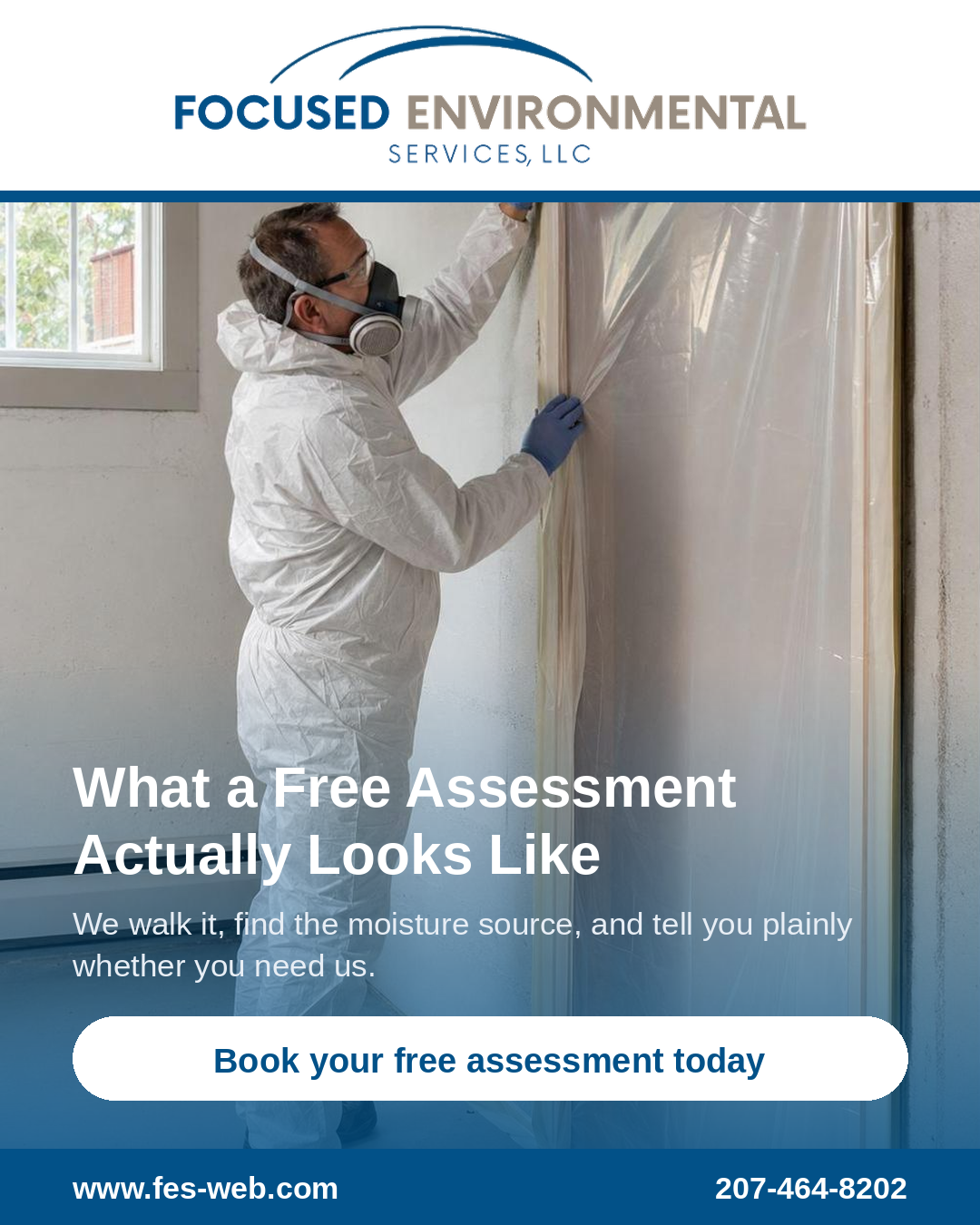
The EPA’s guide for schools and commercial buildings recommends limited containment for areas involving between 10 and 100 square feet of mold contamination, and full containment above 100 square feet. Limited containment means a single layer of 6 mil polyethylene, negative pressure using HEPA filtered fan units, HEPA vacuuming at the end, and at minimum an N-95 respirator, gloves and eye protection. Full containment adds a second layer of poly and a decontamination airlock.
Negative pressure means the machine pulls more air out of the work area than leaks in, so the sheeting sucks inward and stays there. A barrier breathing in and out while the crew works is not holding pressure. The exhaust runs out a window, so the room stays cool and the machine runs all night.
The moisture meter is a comparison tool. A good crew reads the same material somewhere unaffected first, and that becomes the dry standard for your building. Sheathing behind a failed window sits well off that baseline and holds there for days. The identical panel two feet away does not move.
What actually drives the price
Not the mold. Access drives it. Contained square footage, whether the material is porous, whether a wall has to be opened, and how much of the building goes back together afterward. We keep a separate page on what mold remediation costs in Maine. We will not print a range here, because a range with no building behind it is bait.
The work that starts before the heat comes on
The EPA, in guidance last updated February 18, 2026, says to keep indoor humidity below 60 percent relative humidity and ideally between 30 and 50 percent, and states plainly that the key to mold control is moisture control. Right now the Maine problem is humid outdoor air meeting cool basement walls. In November it inverts, and moisture finds the coldest surface in the building.
You do not need a contractor for any of that. Put a cheap hygrometer where the trouble is. Drain the dehumidifier to a pump or floor drain, not a bucket somebody forgets. Confirm the bath fan vents outside and not into the attic.
If you own rentals
Maine CDC’s LHO Guide: Mold, dated Winter 2025, puts it simply: a mold problem is a moisture problem. It directs that landlords be notified of mold or active water leaks, and points to Title 14 Section 6021 on habitability. Take complaints in writing, dated, and photograph the dry-out, not just the finished paint.
The same guide states that environmental mold testing is generally not recommended or needed, because there are no set lab standards for safe levels of mold. Pay for environmental testing when you need documentation for a dispute.
Be careful what you tell a tenant about health. The CDC, on a page last reviewed September 26, 2024, says exposure to damp and moldy environments may cause a variety of health effects, or none at all, and that people with asthma or mold allergies may have severe reactions. Symptoms are a conversation with a doctor.
Vetting a contractor in a state that licenses none of this
Maine issues no mold licence, no state mold certification, and no registry you can check. That is exactly why the vetting falls on the owner. Ask for what can be verified: general liability insurance sent directly by the insurer, three Maine references from the last twelve months, IICRC training records with names and dates, written procedures conforming to S520, and a scope you can read. Then ask who performs verification. If the company that did the work also declares it finished, that is not verification.
If the patch is smaller than roughly 10 square feet, about a 3 foot by 3 foot area, the EPA’s position is that in most cases you can handle it yourself. We would rather say that than sell you containment. If mold is in front of you today, start with what to do before you hire anyone. If you want a second read on a scope, our assessment is free.